
Many companies still depend on traditional software. These systems may support sales, finance, customer service, stock management, inventory, and daily tasks. The software can still be in use, but it may function slowly. It may also create security and support issues.
Older software apps may rely on outdated tools and work only on older servers. In addition, it also requires manual work and assistance.
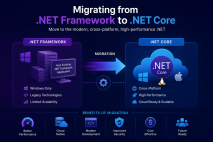
That’s the reason several organisations are migrating from their legacy systems to modern .NET.
Modern .NET allows various companies to enhance their software development and management processes. This technology is entirely adaptable for cloud deployment. Additionally, it operates effectively on all platforms. Furthermore, it also provides high performance and regular updates.
Modern .NET is an open-source, free, cross-platform development. It supports several types of applications and OS (operating systems). Modernisation is clearly not just a technological improvement but rather a business decision.
Effective .NET Migration Services can lower costs and enhance performance. This guide covers benefits, warning signs, migration options, challenges and best practices and explains why companies are moving to modern .NET.
What are Legacy Apps?
Legacy applications are software tools that are no longer new. They used to be part of many companies' daily operations. Although legacy apps may not be too bad, there may be some difficulties related to system maintenance and security.
Legacy apps usually include the following features:
- Old programming languages
- Outdated architecture
- Difficult integration with other systems
- High costs related to maintenance
- Poor scalability potential
- Security concerns
- Low speed
- Run only on Windows
- Have limited cloud support
- Take a long time to update
As technology evolves, these legacy solutions may become more complicated to use and struggle to meet business needs.
Why Are Legacy Applications Becoming a Business Challenge?
Many companies continue to depend on legacy applications. While these systems may still work but it often creates several challenges
Increasing Costs for Maintenance
Legacy applications require consistent maintenance. These applications need older technology and experienced developers. This increases the cost overall.
- Frequent bug fixing
- Legacy hardware is required
- Old infrastructure needs
- Experienced developers are needed
- Significant expenses associated with maintenance
Security Risks
Legacy applications may not support modern security protocols. They are more liable to cyber threats. This results in higher business risk.
- Data breaches
- Data loss
- Financial loss
- Compliance issues
- Loss of customer support
Poor Performance
Business apps must operate rapidly and efficiently. Legacy systems have a tendency to become slow over time, which affects both employees and customers.
- Slow response time
- System downtime
- Performance issues
- Reduced productivity
- Poor user experience
Integration Difficulties
Today's companies make use of a variety of digital solutions. Old software may not work well with these. As a result, there are problems.
- CRM software
- ERP software
- Cloud solutions
- Mobile apps
- External technologies
Limited Scaling Capability
Business needs are rising over time. Old applications might not handle extra work. This situation could limit further growth.
- Increase in the number of users
- Large data volume
- High workloads
- New business feature
- Business expansion
Challenging to Upgrade
Legacy applications become increasingly complicated. It takes longer to make even minor changes. Maintenance and testing are also harder.
- Complex code
- Outdated architecture
- Longer testing periods
- Slow updates
- Greater development effort
These difficulties can slow down business operations. As a result, many companies migrate from legacy applications to modern .NET solutions.
Signs That a Legacy Application Needs Modernization
Not all legacy software must be replaced immediately. However, these signs indicate that it may be a time to modernise.
Slow Performance
The app runs slowly. It takes longer to load pages, which affects productivity and the user experience.
High Maintenance Costs
Costs for maintenance are rising continuously. The company spends more on repairs, existing infrastructure, and maintenance.
Security Threats
Legacy or old applications do not get the required security updates regularly. This raises the security and compliance threat levels.
Slow feature updates
The process of introducing new features takes too long due to the usage of legacy code.
Scalability Limitations
The application is not able to support more users and workloads. It limits the future growth
Integration Challenges
The application is not easily integrated with advanced technologies such as CRM, ERP, cloud technologies or API.
Lack of Technical Assistance
It becomes hard to source developers with legacy technology skills. This increases support costs.
Outdated Infrastructure
The application relies on old servers and operating systems. This decreases its flexibility.
Why Businesses Are Moving to Modern .NET?
With modern .NET, companies can deal with the problems with legacy applications. .NET is open-source and cross-platform and was created to enable modern software development. It can be used for web, cloud, desktop, mobile, API, and enterprise solutions.
Below you will find the most important reasons why companies are adopting modern .NET solutions.
High Application Performance
Performance is one of the main objectives of modernization. Modern .NET allows for faster and more responsive apps.
Benefits include:
- Faster loading of web pages
- Faster response of the API
- Lower memory consumption
- Better handling of workload
- Improved user experience
- Better performance on the cloud
This allows boosting productivity and saving costs on infrastructure.
Stronger Security
Today's companies need enhanced levels of security. With modern .NET, exceptional security features are available, and upgrades happen automatically.
Benefits include:
- Built-in security features
- Regular updates in the terms of security
- Enhanced protection of data
- Better compliance
All these elements make business applications safe from the latest cybersecurity attacks.
3. Long-Term Support
Companies are looking for a platform that they can rely on for several years. Modern .NET follows the Long-Term Support (LTS) release cycle established by Microsoft.
Benefits include:
- Frequent updates are provided
- Support for the long term
- A stable application
- Future upgrades will be easier
This boosts confidence among businesses regarding development in the long term.
4. Cross-Platform Support
Currently, various operating systems are used in business sectors, which is why using the latest version of .NET is beneficial.
Benefits include
- Installation on different platforms (Windows, Linux, and MacOS)
- Various hosting options
- Reduced infrastructure dependency
- Wide application ranges
As a result, companies gain maximum flexibility.
5. Better Cloud Support
Today, cloud computing is important for most companies. The modern version of .NET was designed for development in the cloud.
Benefits include:
- Deployment is simple
- Scaling is flexible
- Availability is high
- Support for recovery from disasters
This helps companies to build scalable cloud applications
6. Easier scaling
All business applications have to evolve in accordance with the development of the company. The modern .NET technology makes it much easier.
Benefits include:
- Support of multiple users
- Improved workload management
- Easy feature expansion
- High availability of the application
All these features ensure the company is prepared for even more growth in the future.
7. Speed of Development
Today's .NET includes advanced technologies and reusable components. These allow software developers to work without effort and with success.
Benefits include:
- Fast development
- Easy testing
- Fast bug fixing
- Faster features release
This decreases the development time and cost.
Easier Integration
Modern companies work with numerous software platforms. Modern .NET can connect easily to the business systems.
Benefits:
- Integration of ERP systems
- Integration of CRM systems
- Cloud connection
- Support of third-party APIs
This simplifies the whole process of business workflow.
Support for Microservices
Startups are adopting microservices more frequently. The modern .NET supports this architecture completely.
Benefits include:
- Services that function independently
- Easy installation
- Improved scaling
- Updates done in a higher speed
Thus, enterprise applications become more agile.
Container Support
Containers simplify application deployment. Modern .NET works well with Docker and Kubernetes.
Benefits include:
- Faster deployment
- Better portability
- Easier scaling
- Consistent environments
This improves deployment efficiency.
11. Improved User Experience
Current technologies have to be easy and quick in operation. Modern .NET provides better capability to create user-friendly interfaces and ensure performance.
Benefits include:
- Quicker workflows
- Mobile-friendly design
- Enhanced dashboards
- Improved accessibility
These increase the satisfaction level of clients and employees.
12. Support Modern Business Needs
Modern-day business requirements continue to evolve. Modern .NET supports today’s digital technology.
The benefits include:
- Cloud application support
- AI integration
- Automation of processes
- Analytics at real time
This enables companies to remain competitive.
Ways to Modernize a Legacy .NET Application
There is no universal solution applicable to all organizations. The proper method will depend on the application, the objectives of the company, costs, and requirements for the future.
Rehost
Move the application into a new infrastructure. Make some minor changes to the code. This is the quickest technique of modernization.
Replatform
Enhance the database, hosting, or deployment technique. The core application and business principles should remain the same.
Refactor
Enhance the codebase. The main features of the application stay the same. This helps in enhancing its performance, scalability, and maintenance efficiency.
Re-Architect
Change the application structure. Use state-of-the-art technologies including microservices, APIs, containers, or cloud technologies.
Re-Create
Develop a completely new application using the modern .NET. This is an appropriate choice if the existing system has become outdated or is hard to maintain.
Why Modern .NET Is a Long-Term Choice
Modern .NET has been created with the aim of achieving long-term success for business. Moreover, it is a lively platform with continuous to release security updates, performance enhancements, support for the that continuesrn development tools.
.NET 10 is the current LTS release as of August 2026. Microsoft provides its support until November 2028.
This makes it possible for companies to use this technology and run their production apps in a reliable and supported ecosystem. Modern .NET technology supports various architectures as well.
Companies have the ability to create:
- Web applications
- APIs
- Cloud-based services
- Software for desktop
- Mobile Software
- Microservices
- Systems based on Containers
- Real-time Software
- Solutions Powered by AI
- Enterprise Platforms
This flexibility makes it useful for present and future requirements.
Conclusion
Legacy apps may still support important work. However, they can limit business growth. They may increase costs. It can also lead to security issues, performance issues, and support issues.
Moving to modern .NET technologies can enhance the speed, security, and maintenance of the systems. Furthermore, it allows for cloud implementation, API integrations, and modern user experience delivery.
The right legacy modernization strategy is to be selected depending on the particular application. Some applications need a simple upgrade, while others must be completely rebuilt.
FAQs
1. What is legacy app modernization?
Modernizing legacy applications involves upgrading old software applications. This can involve modifying code, architecture, database, UI, and software hosting.
2. Why should companies modernize their legacy applications?
Modernization improves the aspects of legacy applications in terms of security, performance, scalability, and user experience. It can also support future growth and decrease maintenance costs.
3. What is modern .NET refer to?
Modern .NET is an open-source platform created by Microsoft for cross-platform development. It supports web, cloud, desktop, mobile, API, and enterprise applications.
4. Is the .NET framework still in use?
Some older versions of the .NET framework have support in cooperation with Windows. However, Microsoft recommends to use modern .NET for new development.
5. Do all .NET framework apps require migration?
No. Those applications that are stable may continue to run. The necessity for migration depends on the business needs, threats, cost, and future objectives.
6. What advantages can be gained by switching to modern .NET?
The core advantages include high performance, robust security, cloud support, cross platform capability, easy maintenance, and enhanced flexibility.
7. Is it possible to migrate legacy applications to the cloud?
Certainly, legacy applications can be re-hosted, re-platformed, modified, or rebuilt for the cloud. The method of migration shall depend on the particular application.
8. How long does a .NET modernisation process take place?
The time for modernization process depends on the complexity of the application. Small upgrade may take weeks, while larger-scale projects may take several months.
9. What is the best way to modernize a large application?
It is recommended to apply a gradual approach to modernization as it is more reliable. Teams can modernize a single module or service at a time. This decreases disruption and makes testing simple.
10. Is .NET 10 suitable for enterprise applications?
Yes. .NET 10 is an LTS release. It is designed for production use and is supported by Microsoft until November 2028.