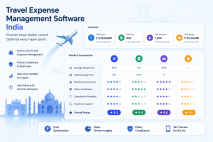

The pharmaceutical industry runs on movement. Medical representatives travel to meet healthcare professionals, sales teams visit hospitals and distributors, researchers attend conferences, clinical teams travel to study locations, and executives move between offices, manufacturing facilities, and business meetings.
Flights, hotels, local transportation, meals, fuel, conference registrations, client meetings, and other business costs can quickly become difficult to track. When these expenses are managed through spreadsheets, emails, paper receipts, or disconnected systems, finance teams often spend significant time checking claims, correcting errors, following up for missing documents, and preparing reports.
This is where travel and expense management software for the pharmaceutical industry becomes valuable.
A modern travel expense management platform can bring travel requests, approvals, bookings, expense claims, reimbursements, policy controls, and reporting into a single digital workflow. For pharmaceutical companies with large field teams and strict financial controls, this can improve visibility while reducing administrative work.
Why Travel and Expense Management Is Different in Pharma Industry?
Travel and expense management is important in almost every industry, but pharmaceutical companies have some specific requirements.
A pharma organization may have hundreds or thousands of employees travelling across cities or countries. Medical representatives and sales personnel may submit expenses frequently, while clinical research and corporate teams may have completely different travel requirements.
At the same time, pharmaceutical companies typically operate with defined spending policies and approval structures. Expenses may need to be associated with a particular employee, department, territory, project, cost center, customer interaction, conference, or business activity.
Managing this manually creates several challenges.
Finance teams may have to verify receipts individually. Managers may approve expenses without complete visibility into historical spending. Employees may submit duplicate claims. Travel bookings may happen outside approved channels. Expense reports may reach finance weeks after the actual spending occurred.
A centralized travel and expense management software solution can address many of these issues by creating standardized processes across the organization.
Common Travel and Expense Challenges Faced by Pharmaceutical Companies
1. High volume of field expenses
Pharmaceutical sales teams can generate a large number of small and medium-value expenses every month.
Fuel, taxis, parking, meals, lodging, and other local expenses may appear individually insignificant. At scale, however, they represent a substantial operating cost.
Manually processing thousands of transactions makes it harder to identify spending patterns and policy violations.
2. Paper receipts and manual data entry
Employees often receive invoices and receipts in different formats. Some may be physical receipts, while others arrive as PDFs, emails, or digital invoices.
Entering this information manually into spreadsheets or accounting systems consumes time and increases the possibility of errors.
With an automated system, employees can upload receipts through a mobile application. Depending on the platform, OCR technology can extract information such as merchant name, date, tax amount, and total value, reducing manual data entry.
3. Complex approval structures
A pharmaceutical organization may have several layers of approval.
For example, a travel request might require approval from a reporting manager, regional manager, finance department, or business head depending on the employee's role and the expense amount.
A digital approval workflow can automatically route requests to the appropriate approver.
This reduces email-based coordination and provides a record of who approved each request.
4. Difficulty enforcing expense policies
Pharma companies may define different policies based on employee grade, location, travel type, department, or business purpose.
For example, accommodation limits for a senior executive may differ from those for a field sales employee.
An T&E management system can apply configurable policy rules during submission and approval. Employees can receive an alert when a claim exceeds the permitted limit, while managers can review exceptions before reimbursement.
5. Limited visibility into travel spending
When bookings and reimbursements are managed through separate systems, finance teams may not have a complete view of travel expenditure.
A centralized platform can bring together travel and expense data, helping organizations analyze spending by employee, department, location, category, project, or cost center.
That information can support budgeting and financial planning.
Key Features of Travel and Expense Management Software for Pharma?
Not every expense platform is designed for the complexity of pharmaceutical organizations. Companies should evaluate software based on the workflows their employees actually use.
Travel request and approval
Employees can submit travel requests before making a booking.
The request can include the travel destination, dates, purpose, estimated cost, and other relevant information. Once submitted, it can move through a predefined approval hierarchy.
This creates control before the expense occurs instead of discovering policy issues after reimbursement.
Integrated travel booking
Some travel and expense platforms provide access to flight, hotel, and other travel booking capabilities.
When employees book through approved channels, companies can gain better visibility into travel costs and policy compliance.
It also becomes easier to compare planned travel costs with actual expenses.
Mobile expense reporting
Field employees are rarely sitting at a desk when they incur business expenses.
A mobile travel expense management application allows them to create claims immediately after spending money.
They can capture a receipt, enter the business purpose, select the expense category, and submit the claim directly from their phone.
For medical representatives and field sales personnel, this can significantly simplify expense reporting.
Receipt scanning and OCR
Receipt scanning can automate the extraction of important information from invoices and receipts.
Instead of manually entering every transaction, employees can upload an image and allow the system to capture relevant fields.
This can improve data accuracy and reduce repetitive administrative work.
Automated approval workflows
Approval workflows can be configured according to organizational requirements.
Different workflows can also be created for different expense categories, employee grades, or spending thresholds.
Policy enforcement
A strong travel expense management platform should allow organizations to configure expense policies.
Rules can cover:
- Daily travel allowances
- Hotel limits
- Meal expenses
- Local transportation
- Mileage and fuel
- Employee grade
- Travel destination
- Expense categories
- Approval limits
- Required supporting documents
The objective is not simply to reject expenses. It is to make company policies easier to follow and easier to monitor.
How Pharma Companies Benefit From Expense Automation?
Faster reimbursements
Manual expense processing can create delays because claims move between employees, managers, finance departments, and accounting systems.
Automated workflows can reduce unnecessary back-and-forth and give employees visibility into claim status.
Faster processing can also improve the employee experience for field-based teams who frequently incur out-of-pocket expenses.
Better control over spending
Real-time or near-real-time expense visibility gives finance teams more control.
Instead of waiting until the end of the month to analyze spreadsheets, managers can monitor spending as claims are submitted.
Unusual spending patterns can then be investigated earlier.
Reduced duplicate claims
Duplicate expense submissions can be difficult to identify manually.
Software can compare information such as transaction amount, date, merchant, employee, and receipt details to identify potential duplicates.
This does not replace human review, but it gives finance teams an additional control mechanism.
Improved audit readiness
Pharmaceutical companies need reliable financial records.
A digital expense system can maintain records of expense submissions, receipts, approvals, policy exceptions, and reimbursements.
Having this information organized in one system can make internal reviews and financial audits easier.
Better employee experience
Employees generally do not want to spend hours preparing expense reports.
A mobile-first process can make expense submission simpler.
The simpler the process, the more likely employees are to submit accurate information on time.
Travel and Expense Management for Medical Representatives
Medical representatives are one of the most important user groups for pharma travel expense management.
Their work often involves frequent travel between healthcare facilities, clinics, hospitals, and other locations.
A dedicated medical representative travel expense management system can help organizations manage:
- Local travel expenses
- Mileage and fuel claims
- Public transportation
- Meals
- Hotel expenses
- Parking and tolls
- Customer meeting expenses
- Daily allowances
- Travel advances
- Reimbursements
Mobile expense reporting is particularly useful because field employees can submit expenses while travelling rather than waiting until they return to the office.
Companies can also analyze expenditure by territory, employee, region, or business unit.
The Role of Data and Analytics
Travel and expense management software should not only process claims. It should also turn expense data into useful business information.
For example, finance teams can analyze:
- Total travel expenditure
- Average expense per employee
- Spending by region
- Hotel expenditure
- Air travel costs
- Fuel and mileage costs
- Policy exceptions
- Pending reimbursements
- Department-wise spending
- Month-on-month expense trends
These reports can help identify areas where travel budgets are increasing and where policies may need adjustment.
For pharmaceutical companies with geographically distributed field operations, this level of visibility can be particularly useful.
What to Look for When Choosing Travel Expense Management Software?
Before selecting a platform, pharmaceutical companies should evaluate more than the user interface.
Look for:
Mobile accessibility: Field employees should be able to submit expenses easily from their smartphones.
Configurable workflows: Approval processes should support different departments, employee levels, and spending limits.
Policy controls: The system should allow organizations to define and enforce their own travel and expense policies.
Receipt management: Employees should be able to capture and store supporting documents digitally.
Reporting: Finance teams should have access to detailed expense reports and dashboards.
Accounting integration: The platform should integrate with existing accounting, ERP, payroll, or financial systems where required.
Security: Expense and employee data should be protected through appropriate access controls and security practices.
Scalability: The software should be able to support organizational growth and geographically distributed employees.
Moving From Manual Expenses to Digital Expense Management
Replacing spreadsheets with software is not simply a technology upgrade. It changes how an organization manages spending.
A successful implementation usually starts by mapping the existing process.
Companies should identify how travel is requested, who approves it, how bookings are made, how expenses are submitted, how claims are verified, and how reimbursements reach employees.
The organization can then configure the digital workflow around these requirements.
Employee training is equally important. Even sophisticated software will not deliver its full value if employees do not understand expense policies or how to submit claims correctly.
A phased rollout can also help. Companies can begin with a specific department, region, or employee group before expanding the system across the organization.
The Future of Travel and Expense Management in Pharma
Travel and expense management is moving toward increasingly automated and data-driven processes.
Artificial intelligence, OCR, automated policy checks, mobile applications, digital payments, and integrated financial systems are reducing the amount of manual work involved in expense administration.
The next generation of travel expense management software will likely focus even more heavily on real-time visibility, intelligent anomaly detection, automated compliance checks, and predictive spending analysis.
For pharmaceutical companies, the goal is not simply to process reimbursements faster. It is to create a controlled and transparent expense ecosystem that supports employees while giving finance teams better information.
Conclusion
Pharmaceutical companies manage complex travel and expense requirements across sales, medical, research, operations, and corporate functions. Manual processes can make it difficult to control spending, enforce policies, process reimbursements, and maintain accurate records.
Travel and expense management software for the pharmaceutical industry provides a centralized way to manage travel requests, bookings, expense claims, approvals, receipts, reimbursements, and reporting.
For organizations with large field teams and frequent business travel, the combination of mobile expense reporting, automated workflows, policy controls, and analytics can create a more structured approach to expense management.
The right solution should fit the company's existing policies and financial processes while remaining simple enough for employees to use every day. When those two requirements come together, travel and expense management becomes less of an administrative burden and more of a controlled, data-driven business process.