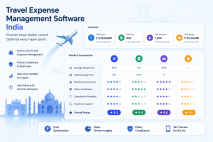

Managing business travel and employee expenses is one of those things every finance team dreads. You've got a pile of paper receipts, a dozen messages from employees asking for reimbursements, and spreadsheets that are three updates behind. Sound familiar?
If you're running a business in India, this problem hits harder than most. Between GST compliance, multi-city travel approvals, and the sheer volume of employee claims, manual expense management is a recipe for chaos. That's exactly why travel and expense management software has become a must-have for Indian companies of all sizes.
In this guide, we break down what T&E software does, what to look for, and how the top tools in the Indian market compare with a special focus on SpendMantra, which has quietly become the go-to choice for finance teams across the country.
What Is Travel and Expense Management Software?
Simply put, T&E software helps companies track, approve, and reimburse employee spending on business travel, meals, client entertainment, and other work-related costs.
Instead of employees submitting hand-written claim forms or sending receipts over email, everything goes through one platform. Managers approve requests digitally. Finance gets real-time visibility. And employees get reimbursed faster.
Good T&E software also plugs into your accounting system, ensures GST compliance, and gives leadership the data they need to spot overspending before it becomes a problem.
Why Indian Businesses Need Purpose-Built T&E Software?
India has some specific compliance and operational requirements that generic global tools often miss.
GST Input Tax Credit (ITC): When employees book hotels or flights for business, companies can claim GST ITC but only if the invoice has the right details and is filed correctly. A tool that doesn't capture GST numbers automatically leaves money on the table.
Multi-tier approval workflows: Most Indian companies have layered hierarchies. An employee might need approval from their manager, then a department head, then Finance. Any software that only supports single-level approvals is going to create bottlenecks.
Currency and forex handling: Companies with employees travelling internationally need tools that handle forex rates, per-diem policies across different countries, and multi-currency reimbursements.
Integration with Indian payroll and ERP systems: Tools like Tally, SAP India, and Zoho Books are widely used. Your T&E platform must talk to them cleanly.
If your current tool doesn't handle these, you're not just dealing with inconvenience you're risking compliance issues and leaving tax savings unclaimed.
Key Features to Look For
Before we get into the comparison, here's a quick checklist of what a solid T&E platform should offer:
- Mobile receipt capture: Employees snap photos of receipts on the go
- Automated policy enforcement: Flags out-of-policy expenses before approval
- Multi-level approval workflows: Configurable by department, grade, or expense type
- GST compliance: Auto-capture of GSTIN, tax breakdowns, and ITC reports
- Travel booking integration: In-app booking for flights, hotels, and cabs
- Real-time dashboards: Spend visibility by team, project, or cost centre
- ERP/accounting integrations: Connects with Tally, SAP, QuickBooks, Zoho
- Corporate card support: Auto-reconciliation of card transactions
- Analytics and reporting: Trend analysis, budget vs. actual, policy violations
- Multi-currency support: Essential for international travel
Top Travel and Expense Management Tools in India
Let's look at the main players and how they stack up.
1. SpendMantra
SpendMantra is built specifically for the Indian market, and it shows. From the moment you set it up, you can tell the team understood what Indian finance teams actually deal with on a daily basis.
The platform handles end-to-end expense management from the moment an employee requests a travel advance to the final reimbursement entry in your accounting system. What makes SpendMantra stand out is how naturally it handles Indian compliance requirements without making the user experience clunky.
GST automation is a highlight. When an employee uploads a receipt, SpendMantra reads the GSTIN, tax amount, and SAC/HSN code automatically. It generates ITC reports that are export-ready, so your tax team isn't spending hours reconciling expense data every quarter.
The approval workflow engine is one of the most flexible in this space. You can set up rules by employee grade, expense category, project code, or cost centre. If your company has five levels of approval for international travel but only two for local meals, SpendMantra handles that logic without any custom development.
The travel booking module integrates directly with flight and hotel inventory, so employees book within policy and get approval as part of the same flow. No more "I booked it myself and need reimbursement" situations.
Analytics and dashboards are genuinely useful. Finance leaders get real-time visibility into pending approvals, policy violation rates, top spenders, and budget utilisation all in one screen. You can slice the data by department, project, city, or time period.
SpendMantra also supports advance management natively employees can request a travel advance, get it approved and disbursed, and settle it against actual expenses all within the platform. This is something many tools handle badly or not at all.
Customer support is India-based, and the team is responsive during IST business hours. Onboarding is structured, and most companies are live within two to three weeks.
2. Zoho Expense
Zoho Expense is a popular choice, especially for companies already using the Zoho ecosystem. It's affordable, has a clean interface, and handles basic expense reporting well.
The GST support is reasonable but not as deep as SpendMantra. You can capture GSTIN and tax amounts, but generating ITC-ready reports requires more manual steps. The travel booking module is basic it's more of a link to third-party tools than a native booking engine.
Approval workflows are somewhat limited in complexity. For large enterprises with many approval layers and exception handling rules, Zoho Expense can feel restrictive.
It's a solid choice for small to mid-size businesses already on Zoho Books or Zoho People. For larger or more compliance-heavy organisations, you'll likely find the gaps frustrating.
3. Happay
Happay was one of the early T&E players in India and built a strong reputation in the corporate card space. It handles card transaction reconciliation well and has decent reporting features.
However, Happay's strength is tied closely to its card product. If you're not using their corporate card, the platform's value decreases significantly. The expense management tool on its own is functional but less feature-rich compared to SpendMantra.
GST handling is available but requires some configuration. The travel booking experience is limited, and multi-currency support has room for improvement. Larger enterprises have reported that the approval workflow customisation takes considerable effort to set up and maintain.
Pricing has also been a concern for some customers the card and software bundling can make cost comparison tricky.
4. SAP Concur
SAP Concur is the global giant of expense management. It's powerful, deeply integrated with SAP's ERP suite, and has robust policy enforcement tools.
The challenge for Indian companies is that Concur was built for a global (primarily Western) market. GST compliance support has improved over the years, but it's not as seamless as a tool built for India from day one. The interface is complex, and onboarding takes months rather than weeks.
For large enterprises already running SAP ERP, Concur makes sense as part of the ecosystem. For mid-market companies, the cost and complexity often outweigh the benefits. Local customer support is limited, and issues often go through global queues.
5. Fyle
Fyle has made a name for itself with its Gmail and Outlook integration employees can submit expenses directly from their inbox. It's a clever UX approach and genuinely reduces friction for receipt submission.
The platform is well-designed and mobile-friendly. GST support is available, though the ITC reporting depth is not at par with SpendMantra. The travel booking capability is minimal.
Fyle works best for companies with relatively straightforward expense policies. If your organisation needs complex approval hierarchies, advance management, or deep ERP integration, Fyle starts to show its limits.
Feature Comparison Table
GST ITC Auto-Capture
| Feature | SpendMantra | Zoho Expense | Happay | SAP Concur | Fyle |
| ✅ Full | ✅ Partial | ✅ Partial | ✅ Partial | ✅ Partial | |
| Multi-Level Approvals | ✅ Highly flexible | ⚠️ Limited | ✅ Moderate | ✅ Good | ⚠️ Basic |
| Native Travel Booking | ✅ Yes | ⚠️ Basic | ❌ No | ✅ Yes | ❌ No |
| Advance Management | ✅ Yes | ⚠️ Limited | ✅ Yes | ✅ Yes | ❌ No |
| Corporate Card Reconciliation | ✅ Yes | ✅ Yes | ✅ Strong | ✅ Yes | ✅ Yes |
| Mobile App (iOS + Android) | ✅ Yes | ✅ Yes | ✅ Yes | ✅ Yes | ✅ Yes |
| ERP Integration (Tally/SAP/Zoho) | ✅ Deep | ✅ Zoho-native | ✅ Moderate | ✅ SAP-native | ⚠️ Limited |
| Multi-Currency Support | ✅ Yes | ✅ Yes | ⚠️ Basic | ✅ Yes | ✅ Yes |
| Analytics & Dashboards | ✅ Rich | ✅ Good | ✅ Good | ✅ Rich | ✅ Moderate |
| India-Based Support | ✅ Yes | ✅ Yes | ✅ Yes | ❌ Global | ✅ Yes |
| Onboarding Speed | ✅ 2–3 weeks | ✅ Fast | ✅ Moderate | ⚠️ Months | ✅ Fast |
| Pricing (SME-Friendly) | ✅ Yes | ✅ Yes | ⚠️ Bundle-heavy | ❌ Premium | ✅ Yes |
Why SpendMantra Comes Out Ahead?
When you look at the comparison honestly, a few things become clear.
SpendMantra is the only tool in this list that checks every box without requiring workarounds. Zoho Expense is good value but limited in compliance depth. Happay is strong on cards but weaker as a standalone platform. SAP Concur is powerful but overkill for most Indian businesses and slow to deploy. Fyle solves a UX problem but doesn't fully solve the compliance and workflow problem.
SpendMantra was built with the Indian finance team as the primary user. The GST handling is the deepest in the market. The approval workflow engine handles real-world Indian organisational complexity without custom development. The advance management feature solves a problem that every Indian HR and Finance team knows about. And the support team understands Indian business context which matters more than people realise.
If you're a company with 100 to 5,000 employees, operating across multiple cities, dealing with GST, and tired of spreadsheet-based expense tracking, SpendMantra is the most complete answer available.
What to Expect During Implementation?
One concern companies often raise is: how disruptive is the switch?
With SpendMantra, the onboarding process is structured and supported. A typical implementation covers:
- Week 1: Policy configuration expense categories, approval hierarchies, per-diem rules, GST settings
- Week 2: Integration setup connecting your ERP or accounting software, corporate card feeds, HR system
- Week 3: User training and pilot a small group goes live, feedback is collected
- Week 4 onwards: Full rollout with support
Most finance teams report that employees adapt quickly because the mobile app is intuitive. The bigger win is usually on the finance side the time saved on reconciliation, ITC claims, and audit preparation adds up fast.
Conclusion
Travel and expense management is one of those operational areas where the right software pays for itself quickly. Faster reimbursements mean happier employees. Automated policy checks mean fewer exceptions to chase. Proper GST capture means real tax savings.
The Indian market has several solid options, but if you want a platform built for Indian compliance, Indian approval structures, and Indian finance teams SpendMantra is the clear front-runner.
It's worth scheduling a demo and walking through your specific policy requirements. In most cases, companies find that SpendMantra handles their use cases out of the box, without the months of configuration that global tools often demand.
Disclaimer: This article covers travel and expense management software options available in the Indian market as of 2026. Feature availability may vary by pricing tier and region. Always verify current capabilities directly with vendors.