
Many companies want applications that are fast, secure, and easy to manage. They also want software that can grow with them as their business grows. Older technologies can’t keep up with all these demands.
For many years, the .NET Framework has helped companies build reliable Windows applications. It is still used by many organisations today. However, modern companies want much more. They require apps that are cloud-based, support multiple platforms, have higher performance, and allow faster development.
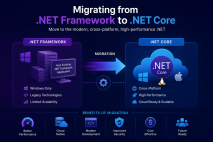
That’s why many organisations are shifting from .NET Framework to .NET Core.
The modern .NET platform provides superior performance, cross-platform capabilities, easy scalability options and lower maintenance costs.
In this blog, Let’s discuss Why organizations are upgrading to .NET Core from the .NET framework, the benefits of migration, challenges and best practices for successful upgrading.
What Is .NET Framework?
.NET Framework is a software development platform introduced by Microsoft. It is an old version, and it primarily supports the development of applications that run on Windows, such as desktop applications, web applications, and enterprise software.
Numerous companies rely on the .NET Framework for the following reasons:
- Their apps function effectively.
- Their everyday operations rely on it.
- Migrating to a new platform takes time and planning.
Microsoft continues to provide the .NET Framework with essential updates and security fixes. But the modern .NET platform will focus on innovations and features. Therefore, many companies are migrating to .NET Core as their primary development tool for new applications.
What Is .NET Core?
.NET Core is a new open-source platform for developing software introduced by Microsoft. Since it is a cross-platform framework, it can run on Windows, Linux, and macOS. Compared to previous versions of .NET, .NET Core was designed to support the needs of modern application development, cloud solutions, API's and microservices.
The main features of .NET Core are as follows:
- Cross Platform
- High Performance
- Cloud-Ready Architecture
- Open Source
- Easily Scalable
- Faster Deployment
Today, .NET Core is the recommended platform for developing modern, safe, and highly scalable enterprise applications.
Why Are Businesses Migrating from .NET Framework to .NET Core?
There are many companies transitioning away from the .NET Framework into .NET Core. The primary reason for this transition is the ability of .NET Core to provide better performance, enhanced security, and compatibility with modern technologies than .NET Framework. Additionally, one of the greatest benefits that .NET Core provides is the capability for developing applications that will allow companies to expand and evolve alongside growth in technology.
The following are some of the main factors why organizations are migrating from .NET Framework to .NET Core.
Improved Performance
An important reason that companies use .NET Core is to increase the speed of their applications, with faster loading and responding times. As well, it can handle more users without slowing down. Benefits include:
- Faster application load time
- Improved end user experience
- Increased productivity
- Improved response times
- Reduced infrastructure costs
Cross-Platform Support
The biggest drawback of the .NET framework was its ability to work only with Windows. On the other hand, .NET Core functions perfectly well in Windows and Linux as well as macOS. So this version allows more flexibility for companies while building and deploying their apps. Benefits include:
- More hosting options
- Greater flexibility
- Easier cloud deployment
Cloud-Ready Development
There are many reasons why companies move their applications into the cloud. Thus, .NET Core was specifically created for cloud development. It integrates really well with all the large cloud platforms, including Microsoft Azure, AWS, Google Cloud and more. Its benefits include
- Faster cloud migration
- Better scalability
- Increased reliability
- Easier disaster recovery
Easy Scalability
As business grows, the apps should also grow with it. Thus, .NET Core provides a way to make it easier to handle more users, huge workloads and future business needs without compromising on performance. Business Benefits includes:
- Supports business growth
- Handles peak traffic
- Improves application stability
- Reduces downtime
Lower Operating Costs
For every business, reducing cost is important. With .NET Core you can easily lower your development, hosting & infrastructure costs while using system resources efficiently. This will eventually save costs. Key benefits include the following:
- Lower server costs
- Reduced licensing expenses
- Better resource management
- Improved ROI
Strong Security
Security is an important component for each business. .NET Core offers built-in security features and also has frequent updates provided by Microsoft. Thus. it secures the application against threats and keeps the business data safe. The key benefits include the following:
- Better protection against threats
- Stronger compliance support
- Reduced security risks
- Improved customer trust
Open-Source Platform
.NET Core provides developers with an open-source platform that includes free tools, libraries, and a large community. This helps developers to build applications faster and improves overall app quality. The advantages include
- Faster innovation
- Strong community support
- Continuous improvements
- Better development tools
Faster Development
With .NET Core, you have access to modern tools that allow you to create your application quickly. You will save precious development hours as well as make the maintenance of projects much easier. Benefits include
- Faster development cycles
- Improved productivity
- Better code quality
- Easier maintenance
Microservices Support
The majority of modern applications are using microservices. .NET Core supports that architectural model. This allows one to easily create, update and maintain the apps. Benefits include:
- Faster feature releases
- Easier maintenance
- Better scalability
- Reduced downtime
Future-Ready Technology
Microsoft continues to invest in the modern .NET platform. Suppose your business has migrated to .NET Core; you are able to take advantage of the latest features and stay ahead of technology changes. While, Business Benefits include
- Long-term platform support
- Access to new features
- Easier modernization
- Better competitive advantage
Common Business Challenges with.NET Framework
Numerous companies have been using the .NET Framework for running their business application. But due to changing requirements from time to time, there are lots of challenges in managing & maintaining such an app.
Higher Maintenance Costs
Older applications require more frequent updating, bug fixing, and general support. This increases both maintenance time and operational expenses.
Limited Scalability
Companies are growing, and their apps have to scale too. They also need to handle more users and giant workloads. But legacy apps often struggle to handle growing demands.
Slower Deployment
For legacy apps, deploying updates or introducing new features takes longer. This slows down the development process and delays the improvement.
Windows-Only Platform
.NET Framework primarily functions within the Windows environment. As a result, it limits the deployment choices and decreases the flexibility for modern cloud environments.
Limited Developer Availability
The majority of developers have moved to newer versions of .NET technology for application development. Hence, finding skilled people for .NET framework development has become hard.
Signs Your Business Should Migrate to .NET Core
If your company is experiencing one of the following issues, migrating to .NET could benefit your organization.
- Applications are running slowly.
- Maintenance and infrastructure costs are very high.
- Legacy apps that are out of date
- Plans for cloud migration
- Difficulty managing the growth of the business
- Too much maintenance and bug fixes.
- Experiencing more security concerns than before.
- Need support for multiple operating systems.
- Unable to add new features.
- Software takes a long time to deploy and get updated.
If you identify these signs, it is time to start planning for the migration process. Moving to .NET Core will give you better performance and costs and put your organisation in a position for future growth.
Migration Challenges to Consider
Transitioning from .NET Framework to .NET Core can be challenging. Since there are many variations between business applications, it is important to be aware of the migration challenges prior to beginning the process.
Older applications
Older applications will have some features that are missing from .NET Core. Thus, they need to be modified in order to migrate.
Third-party components
The third-party libraries/tools used in the current application may not work in .NET Core. Therefore, they need to be updated or replaced.
Large apps
Most companies do not migrate their large apps at once. Instead, they migrate them in phases to minimize disruption to daily business operations.
Testing
All apps need to be tested after they have been migrated. This helps to ensure that all features function correctly before they go live.
What Happens After Migrating to .NET Core?
.NET Core migration is a significant step for companies when it comes to enhancing the way they develop and operate their applications. They gain efficiencies in performance, reduce maintenance, and support cloud deployment. This makes it easier to manage the apps. The following table lists examples of how companies will benefit from upgrading from .NET Framework to .NET Core.
|
Before Migration |
After Migration |
|
Windows-only application |
Cross-platform application |
|
Slow updates |
Faster releases |
|
Higher maintenance |
Easier maintenance |
|
Limited scalability |
Better scalability |
|
Traditional deployment |
Cloud-ready deployment |
|
Older architecture |
Modern architecture |
Conclusion
Migrating from .NET Framework to .NET Core is a wise choice for modern enterprises. This framework allows organizations to create quicker, more dependable and robust applications. Additionally, migrating to .NET Core can reduce maintenance expenses. It is designed specifically for cloud-based solutions. With appropriate planning, the migration process will be completed smoothly. Lastly, companies that upgrade to .NET Core today will be ready to grow in the future.
FAQs
1. Why should companies migrate from .NET Framework to .NET Core?
.NET Core provides better performance and robust security features. It also supports cloud-based solutions and cross-platform compatibility. This helps companies to build modern business apps.
2. Can I easily migrate my existing apps that were built using the .NET Framework?
Migrating an existing application from the .NET Framework to .NET Core is usually possible. However, the migration process depends on the app's size and complexity.
3. What is the duration for migrating an application to .NET?
Migration timeframes depend on the size of the app. Smaller application migrations will take less time, while larger business application migrations require a longer duration.
4. Will migration affect my business operations?
Not always. Many organizations migrate in phases. This helps to minimise downtime and enables your business to operate seamlessly.
5. Is Cloud app development supported by .NET Core?
Yes, .NET Core has been specifically designed for cloud development. It provides compatibility with cloud-based services such as Microsoft Azure, Amazon Web Services (AWS), Google Cloud Platform (GCP).
6. Is .NET Core a suitable option for large organisations?
Yes, many large organisations have adopted .NET Core for their enterprise applications. In addition, .NET Core is designed to facilitate business growth and accommodate heavy workloads.
7. Is it mandatory to replace every third-party library?
Not necessarily. Several libraries now exist that provide support for .NET Core. If your third-party library is outdated, it may require either an update or substitute option in order to be compatible with .NET Core.
8. What do I need to check prior to migrating?
You need to examine your existing solution. Review all dependencies to ensure they meet your business needs before developing a migration strategy.