Data collection is extremely vital for companies. They are obtaining all sorts of data from various sources. However, companies struggle with interpreting their collected data. Therefore, they spend lot of time for analyzing their traditional BI (Business Intelligence) dashboards filled with charts and numbers. They also need to determine an exact meaning and follow-up action for this data.
Simple dashboards are not sufficient to meet business data’s increased complexity. Instead, they must provide quick answers, clear insights and smart predictions to stand out in today’s competitive market.
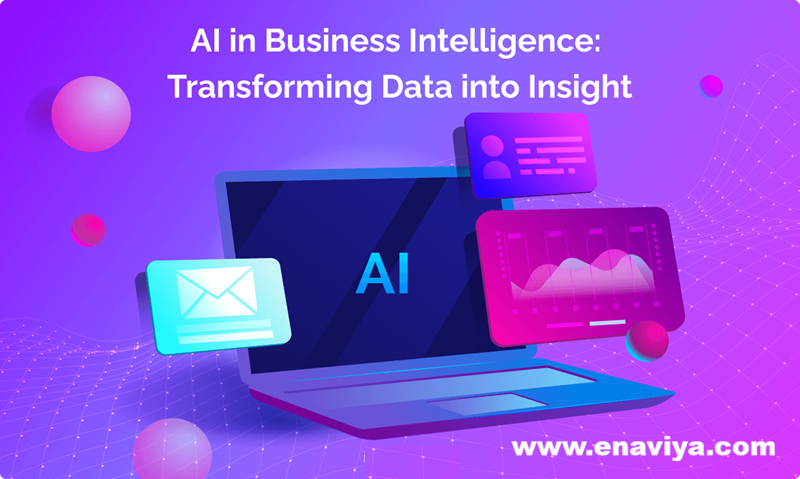
This is where the use of Artificial Intelligence (AI) will assist with Business Intelligence (BI). AI-Powered BI tools will allow businesses to quickly evaluate and analyze vast amounts of data automatically. Through this transition from dashboards to AI-generated insights, Companies gain a better understanding of their data, enhance their overall efficiency, and make faster and more accurate decisions than ever before.
Artificial Intelligence (AI) is much more than just a means of improving dashboards. It completely transformed the way organization understand the data and utilize to make better decisions.
This blog will provide insight into the definition of AI Business Intelligence and why traditional dashboards are no longer enough. It also explains Benefits, Challenges and future trends in AI-Driven BI.
What is AI-Powered Business Intelligence (BI)?
AI powered BI uses machine learning, natural language processing, and analytical processes to help an organization gather, analyze, and interpret data.
In contrast to displaying data purely visually, Business Intelligence Powered by AI:
- Understand patterns in their data
- Recognize trends and anomalies
- Predict future outcomes
- Provide simple explanations of complex data sets
- Offer recommendations for improvement based on the data they collect.
In short we can say, AI turns data into decisions.
Why Traditional Dashboards Are No Longer Enough?
Currently, due to the increased amounts of data being processed, companies need to be able to access fast and precise insights to remain competitive within their industry. Traditional dashboards represent data as numbers or charts. Therefore, they do not provide any explanation of what those numbers represent. As a result, decisions are made at a slower rate and it leads to difficult.
Limitations of Traditional Dashboards
1. Requires Manual Analysis: Dashboards visually present data. Users have to analyze the dashboards manually to interpret the data.
2. Static Data Reports: Dashboards only provide a view of fixed reports with specific metrics that do not adapt to changes in business requirements.
3. No Predictions: Traditional dashboards provide descriptive insight into historical performance but do not forecast future performance or trends.
4. Confusing for Non-Technical Users: Many employees are unfamiliar with dashboard reporting. Most employees would need to be trained on how to interpret dashboard data.
5. Delays in Decision-Making: Because it takes time to extract insights from a dashboard, many companies will wait too long to make a decision.
Due to these limitations of traditional dashboards, companies are now looking toward more intelligent systems that will allow them to quickly and easily access accurate insights.
How AI is replacing Dashboards with Insight
AI supports business intelligence (BI) through analysis of data differently than what would appear through a dashboard. The difference lies in how we present and interact with data. Rather than simply displaying charts and graphs.
AI interprets data by providing simple explanations that allow users to understand what the data really means. Users no longer need to go through number of reports with consuming more time. AI do the complete analysis and provide clear insight.
AI Insights Vs Traditional BI Dashboards
| Traditional BI Dashboards | AI-Powered Insights |
| Show charts and graphs | Explain what the data means |
| Focus on past data | Predict future trends |
| Require manual analysis | Automatically analyze data |
| Provide static reports | Provide dynamic and real-time insights |
| Difficult for non-technical users | Easy for everyone to understand |
| No action suggestions | Recommend next best actions |
| Time-consuming decision-making | Faster and smarter decisions |
How AI Understands Business Data
AI interprets business insights through various modern technologies, including:
- Machine learning (ML). AI understands patterns in business data and uses them to make predictions.
- Natural language processing (NLP): AI translates complex data insights into clear and simple language for easy understanding.
- Predictive analytics: It is applied to business data to understand possible future patterns.
- Anomaly detection: Identifies unusual patterns in business data that may indicate a problem.
AI systems can use information from sales transactional data, customer behavioural data, market trend data, and operational performance data.
Key Features of AI-Powered Business Intelligence
- Automated Data analysis: AI analyzes large volume of data automatically without any manual effort.
- Real Time Insights: AI provides real-time information as data changes become available.
- Simple Language Questions: AI allows the generation of natural language requests for information. Responses can be returned in easily understood terms.
- Future Predications: Predictive analysis of sales, customers, demand and customer behavior using Artificial Intelligence.
- Action Suggestions: AI can provide suggestions on what an ideal action might be for a particular Business.
Benefits of AI for Business Intelligence
- Quicker Timely Decisions:
AI is able to provide insights very quickly so that organization do not have to take the time to manually analyze their data for hours or even days. It allows teams to make timely decisions.
- Better Accuracy
AI reduces the potential for human error when interpreting and understanding data. It also reduces an individual’s personal biases which provide businesses with more reliable insights into the information they collect.
- Improved Productivity
When AI provides the analysis of the data, teams have more time to spend planning, creating, and completing their critical business functions. While also spending less time on producing and preparing reports.
- Scalable Intelligence
AI can easily scale up by allowing you to easily handle large amounts of data as organization expand rather than having to hire additional people for the analysis of their incoming data.
- Easy for Everyone to Use
AI gives insight into data to everyone, not only the users of AI who have technical backgrounds, but anyone who uses the insights is able to take action from them.
Overall, AI-powered Business Intelligence allows businesses to work faster, smarter, and more effectively.
Challenges of AI in Business Intelligence
- Data Quality Problems
AI simply produces the most relevant results based on the data provided. Thus, if this data is incomplete, inaccurate, or out of date, Companies must take steps to ensure that all data used as input to an AI is accurate and up-to-date.
- Difficulties Integrating AI
AI can often be difficult to integrate with either new applications or those that have been in use for many years. Many companies still maintain older systems that may not readily accept new AI programs. Therefore, this integration can sometimes be complicated and require both an investment of time and technical expertise to successfully complete.
- Confidence in AI-Generated Solutions
Most companies are not yet in a position to rely on their AI’s outputs for data analysis or giving insight into how their employees make decisions. They want their staff to understand why AI generates certain results before feeling confident enough to act upon those results.
- Data Security and Privacy
AI programs will access and utilize a tremendous volume of confidential business data to operate. In order to protect this information from unauthorized disclosure, improper use or exploitation, and cyber attacks, companies must utilize best security practices when deploying AI.
The Future of Business Intelligence Is AI-Driven
Business Intelligence is evolving beyond, not just limited to presenting data through graphs and charts. The future of BI will focus on AI to enable individuals to make quicker and better-informed decisions through ease of access to technology.
What’s Coming Next?
- Conversational AI (Chatbots) for BI
Conversational AI (Chatbots) will help individuals communicate with AI assistant as if they were communicating with another human being. Instead of needing to search through complicated data sets, people can simply ask their AI Bot a question and receive clear and quick answers.
- Automatically Generated Business Strategy
AI will evaluate business data and automatically generate intelligent business strategies. This enables organizations to save time and use them more effectively.
- Industry-Specific AI Insight
AI will offer insight related to specific industries, such as IT, retail, healthcare, finance, and manufacturing, through the analysis of your own industries’ data.
- Real-Time Business Intelligence
AI will analyze the latest product data and offer organizations the opportunity to make the best decision without waiting for product knowledge to be developed.
Companies that begin integrating AI into their BI strategies will benefit from having a more comprehensive understanding of their data and whether they are making the best decision. This will also allow companies to grow more quickly than others.
Why Businesses Must Shift from Dashboards to AI Insights
- Speed: AI provides instant results from data entry and analysis, while waiting on report creation will no longer be required with AI.
- Better Decision Making: AI analyses data patterns and trends. This makes better informed decisions.
- Enhanced Customer Experience: AI understands its customers and customize the service to meet those needs better.
- Increased Efficiency: AI removes the time-consuming aspect of manual processes. As a result, it increases team productivity.
- Preparation for Future: AI forecasts and predicts future trends and delivers direction to assist organization in their future business direction.
- Dashboards as Support Tools: Shifting from dashboards to AI insights allows organization to be more effective and to remain competitive.
In Conclusion
Business Intelligence powered by AI enables companies to make sense of their data in a fast and easy way. AI allows users to save time and make decisions faster and more accurately than ever before. Any user, regardless of skill level, will be capable of understanding AI generated insights. In the future, dashboards will continue to exist, but they will serve only as a Supporting tool. Instead, organizations will use AI to provide all necessary answers and recommendations. By using AI for Business Intelligence, organizations will operate more quickly, make smarter decisions and be more prepared for future challenges.
AI Business Intelligence is the use of artificial intelligence to provide industries with an automated method of analyzing their data and providing industries with predictive insights and recommendations without manual effort.
Traditional dashboards presents charts and numbers, while AI BI provides decoding and detailed instructions about the data.
Yes, AI BI tools are made for easy use by all users of all skill levels to ask questions and to get responses in a way that’s easily understandable.
Yes, small business can use AI BI tools to quickly and effectively understand their data, make better and faster decisions, and expand with minimal human resources.
Yes, AI BI can analyze business data as it is captured. And, provide access to real-time insights for quick and effective decision-making.
Yes, if proper security and privacy measures have been established, most AI powered BI tools meet strict data protection standards.
No. Dashboards will still be used, but mainly as support tools. AI insights will play the bigger role in decision-making.