In recent years, software development has been evolving extremely rapidly for a variety of reasons. The majority of organizations depended on the traditional apps to manage the operations, full-fill customer requirements and foster business growth. These applications operates based on the predefined work flows, fixed rules and requires manual efforts.
However, In Today’s digital world, there is a demand for speed, intelligence and automation. Organizations now handle high volume of data, customer needs and complex processes. Traditional Software cannot keep up this speed. That’s where AI Agents are becoming important factor.
AI agents do not simply provide enhanced performance compared to traditional applications, but also possess an advanced ability to think, learn, act and adapt. These characteristics allow organizations to transform from having static software to adopting an intelligent, agile and highly automated business model.
Go through the blog, to understand the key the differences of AI Agents and Traditional Apps. We have also explained, how AI Agents are shaping the future of software development including their challenges and benefits.
What is a Traditional App?
Traditional applications are software programs that are created to complete a specific tasks by using fixed logic and rules.
Some examples of Traditional Apps include:
- Accounting Software
- CRM Systems
- ERP Software
- Mobile Applications
- Web Portals
All these traditional apps are programmed by a developer to perform a defined task.
How Traditional Apps Works
- The user inputs information into the app
- App processes that information according to a defined logic
- Then, returns an output based on the input.
- There is no learning or decision-making involved in the process of producing an output.
If the needs of a business change, the developer must manually update the app.
Limitations of Traditional Apps
For years, Traditional apps were created for organizations to help operate their business effectively. But now, have a lot of limitations in the rapidly changing environment today.
Drawbacks Include:
- Static functionality: Traditional apps do not automatically adapt. Therefore, any change to functionality requires a code update.
- Manual Process: Traditional Apps require a person to analyze prior data recorded, make a conclusion, and then take action based on those conclusions.
- No Learning Capability: Traditional Apps are not capable of learning from recorded data and they cannot improve performance without human supervisions.
- Long Decision Making Time: Analytical reports and dashboards give insights, but those insights require time to analyze.
- Limited Personalization: All users share the same experience with traditional applications regardless of their preferences.
Due to this limitations, organizations are now shifting towards AI powered software solutions.
What are AI Agents?
AI agents are a type of intelligent software that has the ability to analyze and evaluate data. It makes decisions based on the analysis and take action without needing human supervision.
AI Agents differ from standard apps in several ways:
- AI Agents learn from Data
- AI Agents Can Adapt to Change
- AI Agents Can Operate without requiring User Interaction.
- AI Agents Improve Over Time.
In simple words we can say, an AI agent is a smart system that observes, thinks, decides, and acts without constant human control.
How AI Agents Works?
AI agents are powered by advanced technology that includes:
- Machine Learning
- Natural Language Processing
- Predictive Analytics
- Automation Engines.
AI agent capabilities include:
- Observation: Collecting Information through Observation of a System, User, or Environment
- Analysis: Understanding the patterns/trends derived from the collected information
- Decision: Choosing the most appropriate action
- Action: Perform the actual task automatically
- Learning: Improving the quality of the AI agent’s future decisions
With these advanced technologies, AI agents are better than traditional applications in all areas.
AI Agents Vs Traditional Apps: Key Differences
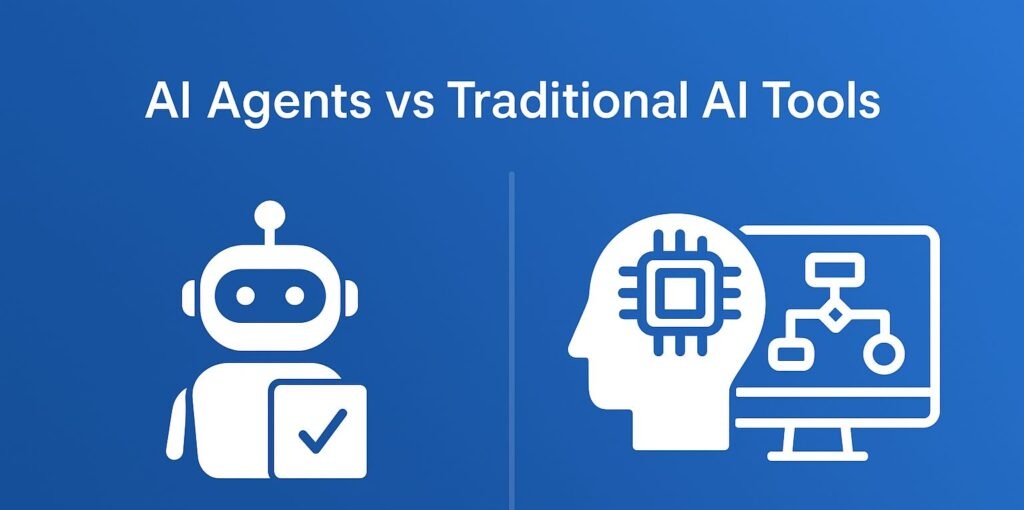
There are some fundamental differences between traditional applications and AI agents in terms of how they operate. Traditional applications require input from a user for every action; they are designed to function based on fixed rules defined by developers.
On the other hand, AI agents have the ability to learn from experience through the input of large amounts of data, create solutions independently, and take action based on information available to them without requiring assistance from humans.
The differences between these two systems are summarized in the table below.
| Feature | Traditional Apps | AI Agents |
| Intelligence | Rule-based | Self-learning |
| Decision Making | Manual | Automated |
| Adaptability | Fixed | Adaptive |
| Data Usage | Historical | Real-time |
| User Interaction | Click-based | Conversational |
| Automation | Limited | Advanced |
| Personalization | Basic | Highly personalized |
| Scalability | Manual scaling | Intelligent scaling |
Why AI Agents are the Future of Software Development?
The future of software development is not just creating more apps. It is all about creating smarter apps.
Key Reasons includes:
- Fast Decisions: AI agents can analyze large volumes of data very rapidly, and quickly take actions without delay.
- Reduce Human Effort: Manual Work has been replaced by intelligent automation.
- Real Time Adaptibility: AI agents can change based on new data from user activity or changes in the marketplace.
- Continuous Improvement: AI agents continually learn from experiences, and the process will automatically improve.
- Reduced Cost: Reduced human Work will also lower operational costs.
Role of AI Agents in Modern Software Development
AI agents are changing how software is designed, built, and used.
Traditional Development Model
- Design → Develop → Deploy → Maintain
AI-Driven Development Model
- Learn → Adapt → Improve → Automate
Developers now focus on guiding intelligence instead of coding
Benefits of AI Agents over Traditional Apps
1. Automation Intelligent
AI agents have the capability to handle complex task by their own without human supervision. At first, they will understand the procedure, make the decisions on their own and complete the task accordingly. This saves time and effort.
2. Improved Accuracy
AI agents are less likely to make mistakes that could happen if the task were done manually or by a human. They follow specific patterns, this helps in avoiding human errors.
3. Increased Productivity
AI agents permit workers to concentrate on tasks that are not repetitive or routine in nature, such as higher-level tasks of creating new content and strategic planning or critical thinking.
4. Improved Customer Experience
AI agents interact in a friendly and casual manner, they engage with clients in a personal way, deliver personalised results and respond quickly to inquiries. This results in user satisfaction
5. Ability to Scale
As your company continues to grow, AI agents can easily absorb and manage the added volume of work. They are able to absorb the increased workload from many more client requests without the need to hire additional employees or create further overhead.
Challenges of AI Agents
While AI agents offer huge benefits, there are some challenges.
- Quality of data
Data is the foundation of AI agents’ performance. If data is incorrect or outdated, then AI agents may produce inaccurate results. As a result, updated data is very important.
2. Integrating with Legacy Systems
Many organizations continue to operate with legacy systems, which complicates the process of integrating AI agents into their existing systems. Additionally, this integration process may require additional resources (time and technical expertise).
3. Trust and Transparency
Many organizations have difficulty trusting AI’s recommendations. In order to trust AI completely, they must understand the justification behind AI’s conclusions.
4. Data Security & Privacy
AI agents process a huge amount of sensitive information. Thus adequate security protections are required to prevent data loss, unauthorized access and cybercrime.
Despite these issues, they can be overcome if appropriate measures are taken to implement.
AI Agents and the Rise of Autonomous Software
Software will eventually become self-sufficient, relying less on humans to complete tasks and will evolve into more autonomous products.
How This Works
- Self-Managed Software: AI Agents will monitor and perform daily tasks without any intervention from humans.
- Automatic Error Repair – Automatically repairing these errors through AI Agents without any input from humans.
- Making Decisions in Real Time – AI Agents will evaluate incoming data in real time and make decisions based on this data whenever time permits.
- Less Dependency on Humans – Most of the time as systems become fully automated, humans will be required only to develop long-term plans and to approve final acceptance.
- Supplementary Digital Employees – In conjunction with digital assistants, AI Agents will provide human employees with assistance.
Overall, AI Agents will provide companies with increased speed, knowledge, and efficiency. By automating the repetitive tasks, AI Agents can allow you to divert your time and focus to the areas of your business that require more creativity or growth.
Future Trends in AI-Driven Software Development
AI-driven Software is growing rapidly, as new trends emerge that shape how applications operate in the near future. Below are five of the most relevant examples of current trends:
- Multi-Agent Systems
Rather than just having one AI agent, a number of different AI agents will work together, with each agent performing one particular task. When an agent completes its task, and has finished processing information, it will share that information with other agents so that they too can complete their work more rapidly.
2. Conversational Software
The interaction with software will take place via voice or chat. Instead of needing to click on buttons or navigate through a series of menus in order to perform actions, users will simply speak or type into the system. This will make software easier to use, as well as more natural for users.
3. No-Code AI Platforms
Companies will be able to create AI-powered applications without writing any code. Companies will use drag-and-drop tools to build applications. This makes AI available to non-technical users.
4. AI Agents for Generating Industry-Specific Solutions
AI agents will be designed to generate solutions for specific fields such as IT, healthcare, financial services, and retail. These field-specific agents will have a better understanding of the requirements and needs of each sector and will produce higher quality results.
5. Real-Time Decision Intelligence
AI will provide real-time analysis of live data, with the ability to provide instant decision assistance. Companies will be able to respond to changes and make smarter decisions based on data in real-time.
Why Organizations Must Move Beyond Traditional Apps
Most current applications do not meet the needs of a company today. The world is changing, and companies require smarter software to navigate the new digital age.
Reasons to Shift
- Fast Market Changes: Customer demands and market trends are constantly changing. Therefore, old or legacy applications cannot keep pace with changes in customer preferences.
- Increased competition: More companies have entered the marketplace, many of which provide similar services. Smart applications help to remain competitive.
- High Customer Expectations: Users are looking for fast, convenient and customised service experiences.
- An exponentially growing amount of data: Companies are now collecting vast quantities of data, but traditional applications are not able to process the data effectively or with sufficient granularity.
Using AI agents will enable company to utilize the above advantages. AI agents utilize the knowledge they derive from data and provide companies with insights and intelligence about their operations.
AI Agents Vs Traditional Apps: Which One Should You Choose?
| Business Need | Best Choice |
| Simple task automation | Traditional Apps |
| Intelligent decision-making | AI Agents |
| Predictive insights | AI Agents |
| Fixed workflows | Traditional Apps |
| Future scalability | AI Agents |
Most organization will use both, but AI agents will lead.
Traditional applications operate on a specified set of operating rules that require human supervision for subsequent app updates. However, an AI agent learns through experience, makes its own decisions, and takes action without human input. This makes AI agents smarter and more flexible.
AI Agents analyse the data, automate tasks and adapts to the new changes. This enable companies to create and deliver better applications faster, based on evolving business requirements.
Yes, AI Agents are better for today’s business needs. They provide the ability to automate tasks, apply their own intelligence, and personalize for specific users. Traditional applications cannot provide these capabilities alone.
Traditional applications will not be entirely replaced by AI agents. Rather, AI agents will work alongside traditional applications to provide a platform for handling the advanced-level, decision-based task.
IT, Finance, Supply Chain, Healthcare, Retail Industries benefit greatly from AI Agents.
Yes, as long as policies regarding data security, privacy, and ethical use of Ai are followed
Most of today’s AI tools have either a low-code or no-code option that allows users to easily create and deploy AI agents without requiring them to have any programming skills.
Organization that adopt AI agents will be more competitive, reduce their operating costs, operate more efficiently, and prepare for the future of software development.
Conclusion
Software development and utilization is changing due to the rise of AI agents. In Past, traditional applications produced useful results, but no longer meet the needs of fast pacing and an increasing level of complexity in today’s digital world. AI agents provide intelligent technology by incorporating automation, learning capability, and rapid decision-making processes.
Future software will comprise intelligent/self-working systems based on AI technology. Therefore, organisations that integrate AI agents into their workflow sooner will increase production speed, fast service delivery to customers, and remains one step ahead of the competition at all times.